Logo of the Berlinischen Galerie
Hallen 07

Jeewi Lee

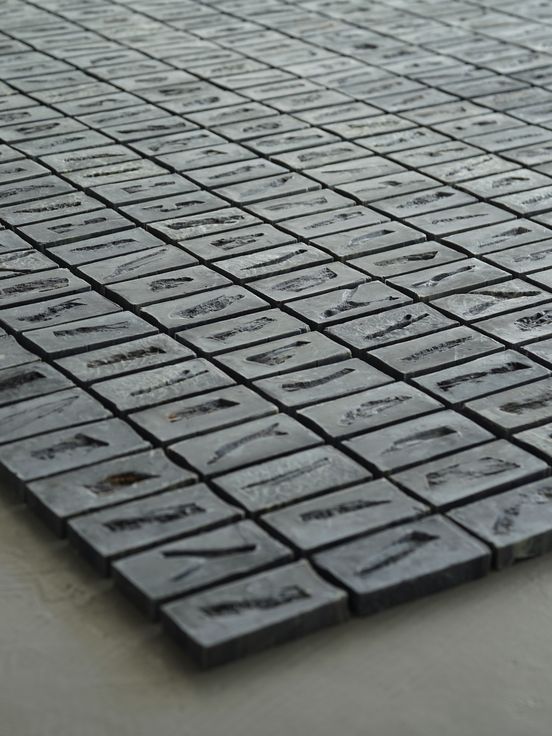
Jeewi Lee, Ashes to Ashes, 2019 – 2021

Jeewi Lee, Ashes to Ashes (Detail, exhibition view "Revision", Städtische Galerie Ostfildern, 2021), 2019-21

© Jeewi Lee, Photo: Jürgen Bubeck

For the art festival Hallen 07 at the Wilhelm Hallen from 5 to 13 September 2026, the Berlinische Galerie presents “Ashes to Ashes” (2019 – 2021) by the Korean artist Jeewi Lee. She made this work following a residency at the Villa Romana in Florence. Its theme is a forest fire on Monte Serra in the Italian province of Pisa in 2018, which destroyed 700 hectares of mountain woodland while she was staying in the region. The artist visited the landscape, took photographs of the apocalyptic scenery – a stark contrast to the romantic view of Tuscany – and collected remnants of the devastating event. This resulted in a series of prints featuring impressions of charred tree trunks and an installation consisting of bars of soap produced by Jeewi Lee, together with a soap-maker, from the ash and carbon particles of burnt trees.

[Translate to English:] Monte Serra nach dem Waldbrand, Februar 2019

Jeewi Lee, Ashes to Ashes (Photo), 2019-21

© Jeewi Lee

Each soap object contains the unique imprint of a scorched tree fragment. The soap bars evoke the purifying effect of ash which, when mixed with oil to form black soap, was already used for washing in ancient times. The title is a reference to a passage in the funeral liturgy: “Earth to earth, ashes to ashes, dust to dust”. It can be read as a ritual of farewell to the lost trees, but it also celebrates nature’s constant self-renewal. Ash, the last material trace of the burnt trees, fertilises the soil, nurturing the potential and the energy to generate new life.

The sculptures and silkscreen prints in the second room are from a series which has been expanding since 2024 in collaboration with the geometry researcher Phillip C. Reiner. Here Jeewi Lee explores grains of sand from different coastal regions, using nano-computed tomography to scan them and then, after a complex process of digitisation, enlarging them up to three thousand times with 3D printers and translating them into art. These sculptures replicate the selected grains of sand down to the tiniest detail and bear an affinity to Korean scholars’ stones (suseok), pieces of rock shaped like miniature landscapes, mountains or animals. In another series Jeewi Lee and Phillip C. Reiner use cross-sections derived from the scans to visualise the density and inner texture of each grain as typical attributes associated with a specific place.

The works on display build a bridge to the exhibition “Residual Memories”which opens at the Berlinische Galerie in 10 September 2026 as part of Berlin Art Week and marks the GASAG Art Prize 2026. There Jeewi Lee combines large-format sand sculptures with other works of sand to create an immersive landscape which is both dystopian and contemplative, evoking the design of Asian gardens.

[Translate to English:] Jeewi Lee, Fragment_Sa Ràpita 23_41, 2024

Jeewi Lee, Fragment_Sa Ràpita 23_41, 2024

© Jeewi Lee & Phillip C. Reiner, Photo: Marcus Schneider

About the artist

Jeewi Lee (*1987 in Seoul, South Korea) studied painting at the University of the Arts in Berlin and at Hunter College in New York. Since 2015 her work has been shown at numerous exhibitions in Germany and abroad. In 2018 she was awarded the Villa Romana prize, in 2021 the junger westen Art Prize and in 2025 a Villa Aurora fellowship. Jeewi Lee lives and works in Berlin.