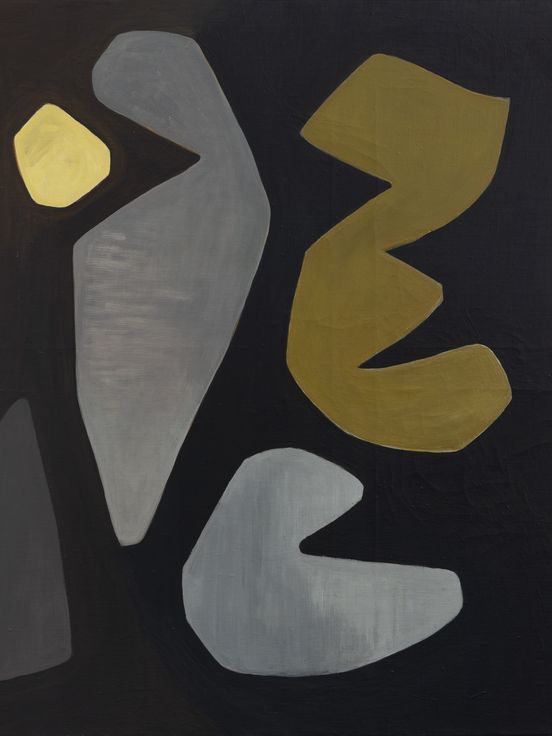
Anna-Eva Bergman (1909–1987) is one of the best-known women’s names in 20th-century Norwegian art. The retrospective at the Berlinische Galerie, covering the years from 1930 until 1970, is the first major exhibition of her work to be staged in Germany. Featuring some 40 paintings and prints, it traces the development of an artist on a resolute quest to establish her own distinctive style.
The show reflects key stages in her work from her early humorous illustrations and drawings with critical social content to the big abstract landscapes that signalled Bergman’s international breakthrough from the late 1950s. Works by Anna-Eva Bergman were selected for prestigious events such as documenta II in Kassel and the Bienal de São Paulo. Norway’s stark natural settings were the springboard for a gradual turn to non-figurative art. In her later works, the impact shifts towards structure, composition and colour. The use of metal leaf brings a singular atmospheric quality to many of her paintings.
Between 1946 and 1952 Bergman channelled experimental energy into an artistic realignment. Berlin also played a role in her life during this period: in 1952 she came to West Berlin to exhibit her latest works, visit the art critic Will Grohmann (1887–1968) and make contact with up-and-coming West German artists.
The exhibition is the result of close collaboration with the Fondation Hartung Bergman in Antibes. Treading in the footsteps of the Verborgenes Museum, the Berlinische Galerie will turn the spotlight on a body of work by a female artist hitherto rarely honoured in Germany.
The exhibition is held under the patronage of Laila Stenseng, Ambassador of the Kingdom of Norway to Germany.