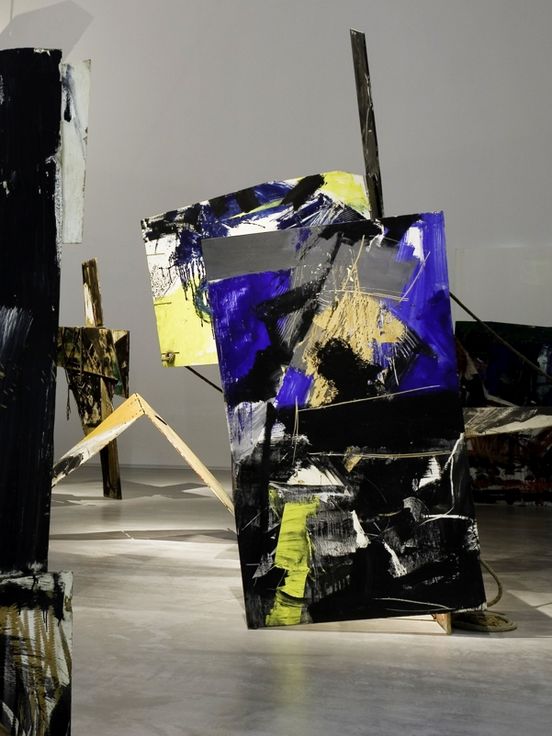
The installation “Absurd Berlin Diary ’64” by Italian painter Emilio Vedova (1919–2006) is one of his most significant works and is unique within his œuvre for its complexity and monumentality.
The work consists of asymmetrical panels sawn from wood, painted on both sides and joined by iron hinges to form movable structures. Vedova called his free-standing, walk-around, pictorial elements “plurimi”. Vedova’s plurimi liberated painting from its conventional confinement to a flat base.
Emilio Vedova (1919–2006) created the work in 1964 while on a grant from the US-based Ford Foundation. This funding enabled the artist to spend a year living and working in West Berlin. His Berlin plurimi were a reaction to the divided city, which Vedova experienced as a “clash of contradictions”. He produced the spatial object in the studio formerly used by Nazi sculptor Arno Breker, which now houses Kunsthaus Dahlem. Later that year it went on show at documenta III in Kassel. In 2002, the artist donated the work to the Berlinische Galerie for its new home on Alte Jakobstrasse.
- All the explanatory exhibition texts are available in German and English.
- There is no information in Simple German.
- There is no information in German Sign Language.
- The exhibition contains video material in spoken Italian with German and English subtitles. The sound comes through loudspeakers.
- There is step-free access to the exhibition.
- Most of the exhibits and explanatory texts can be seen and read from a seated position.
- Objects are dispersed around the whole space. Some stand close together and jut out at different heights.
- There is no seating. Wheelchairs and folding stools can be borrowed free of charge from the cloakroom.
- Most of the exhibition texts are designed with strong contrast.
- The exhibition contains no tactile floor guidance and no touch models.
Click here for information about museum accessibility.
Do you have any other questions about accessibility? Christine van Haaren, Head of Education and Outreach, will be happy to answer them via e-mail haaren@berlinischegalerie.de or via phone +49 (0)30-789 02-836.
From the archive: Absurd Berlin Diary ’64 (exerpts)
Courtesy Fondazione Emilio et Annabianca Vedova and RAI Radiotelevisione Italiana
Excerpts from:
Visiti da vicino – Emilio Vedova
(Take a closer look – Emilio Vedova)
By Renzo Bertoni
1980
L’approdo. Vedova alla Galleria Marlborough
(The Landing – Vedova at the Marlborough Gallery)
By Emilio Garrone
1963
From the archives of Fondazione Emilio et Annabianca Vedova
Scontro di situazioni. Pitura Luce per Montreal
(A clash of situations. Light Painting for Montreal)
Director: Alfredo Di Laura
Production: RAI Radiotelevisione Italiana
1966–67