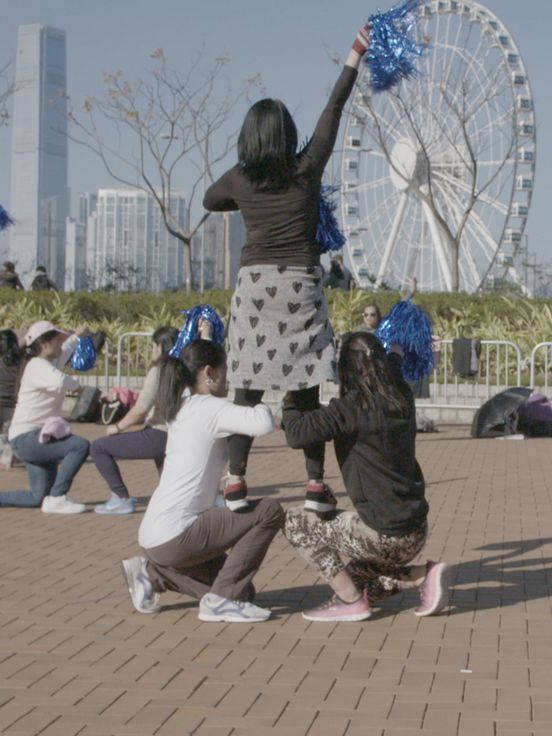
Search for Life I (2024, 20 min.) is a visual exploration of global mobility. The work traces historical shipping routes that date back to the colonisation of the Philippines and are now used by the global container trade. At its centre are the lived realities of former Filipino seafarers: the artist Joar Songcuya and the florist Michael John Díaz. Their biographies are interwoven with the voices of the historian Guadalupe Pinzón Ríos and the lepidopterist Jade Aster T. Badon. The monarch butterfly functions as a connecting motif, its long migration becoming a metaphor for transformation and resilience across generations. Interlacing personal narratives with poetic imagery, the work reflects on diaspora, collective memory and belonging.
In her work, Stephanie Comilang engages themes of labour, technology and postcolonial entanglement in the context of global mobility. Combining documentary footage, fictional elements and personal narratives, she describes her films as “science fiction documentaries”.
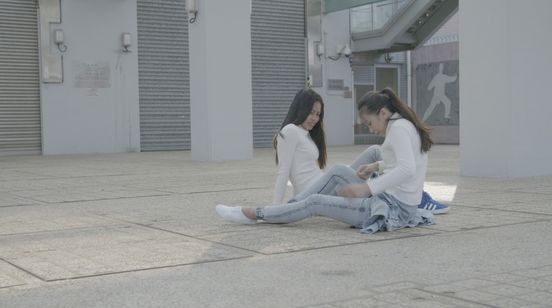
Stephanie Comilang, Come to Me, Paradise, 2017
© Stephanie ComilangCourtesy the Artist and ChertLüdde, Berlin
In Lumapit Sa Akin, Paraiso (Come to Me, Paradise) (2017, 26 min.), the urban space of Hong Kong is imagined from the perspective of Filipina migrant women. The film is narrated by Paraiso, a spirit embodied by a drone, who speaks of displacement, isolation and the search for meaning. On Sundays, thousands of women gather in the financial district, asserting a temporary space of care, community and self-determination beyond the households in which they work and live. This collective presence allows Paraiso to fulfil its task: transmitting the women’s images, voices and messages across distance. Bringing together dystopian architecture, digital technologies and intimate gestures, the film offers a layered reflection on migration, public space and connectedness.

Stephanie Comilang, Search for Life I, 2024
© Stephanie ComilangCourtesy the Artist and ChertLüdde, Berlin and Daniel Faria, Toronto and Fundación TBA21, Madrid

The artist
Stephanie Comilang (born 1980, Toronto) is a Filipino-Canadian artist based in Berlin. She studied at the Ontario College of Art & Design. Recent solo exhibitions include presentations at the Schirn Kunsthalle Frankfurt, the National Gallery of Canada, Ottawa, and the Museo Nacional Thyssen-Bornemisza, Madrid.
Get your tickets now!
Ticket shopIBB Video Space
Since 2011 the IBB Video Space has been screening artists who work with time-based media. The programme features not only established names in contemporary video art but also up-and-coming artists rarely seen in museums to date. For these, the Berlinische Galerie seeks to facilitate an institutional début.
Each screening brings a new encounter with work that raises questions about the medium and about social or political issues. Importance is attached to including marginalised perspectives and to shedding light on the impact of power structures.
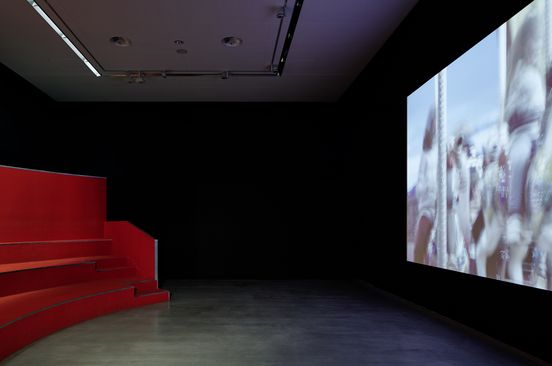
Der IBB-Videoraum in der Berlinischen Galerie
© Noshe